
5. Brain And Mental Health: Start With Safety, Function, And Support
This page is not medical advice. Stroke-like symptoms, altered consciousness, self-harm or suicide risk, severe depression or anxiety, hallucinations or delusions, and clear cognitive or behavior changes need timely professional help or emergency care. This page helps families recognize boundaries, organize information, and build support; it does not provide diagnosis, medication advice, medication changes, psychotherapy, or individualized intervention plans.
Long-term insufficient recovery first affects attention, mood, memory, and judgment. But sometimes the problem is not only poor sleep. A person begins to seem "not quite like themselves." At that moment, what a family needs most is not a label, but a way to judge.
This kind of change often does not arrive with a disease name.
An adult spends several weeks sleeping poorly, feeling palpitations and stomach discomfort, repeatedly checking the report, and the family says, "The clinician said the dangerous things were ruled out. Stop overthinking." An older adult starts missing medications, leaves the stove on, sends money to a stranger, and the family says, "Everyone gets like that with age." A child suddenly refuses school, hides in the room during the day, cannot sleep at night, and the parents' first reaction is, "Are they too fragile, too rebellious, or playing too much on the phone?"
Those words may contain concern, but they share one problem: they explain the state too quickly as personality, age, or willpower.
Brain and mental health are easily misunderstood in two opposite ways. One is dismissing them: low mood is drama, old-age forgetfulness is normal, poor attention means not trying hard enough. The other is over-labeling: one forgotten thing means possible dementia, one anxious period means life is over, one low stretch means rushing to diagnose oneself.
For ordinary families, the steadier starting point is not to decide "what disease is this?" It is to look at four things first: safety, function, pattern, and support. Together, these four questions let the family stop swinging between "is this overthinking?" and "is this some disease?" and first ask whether life has truly changed.
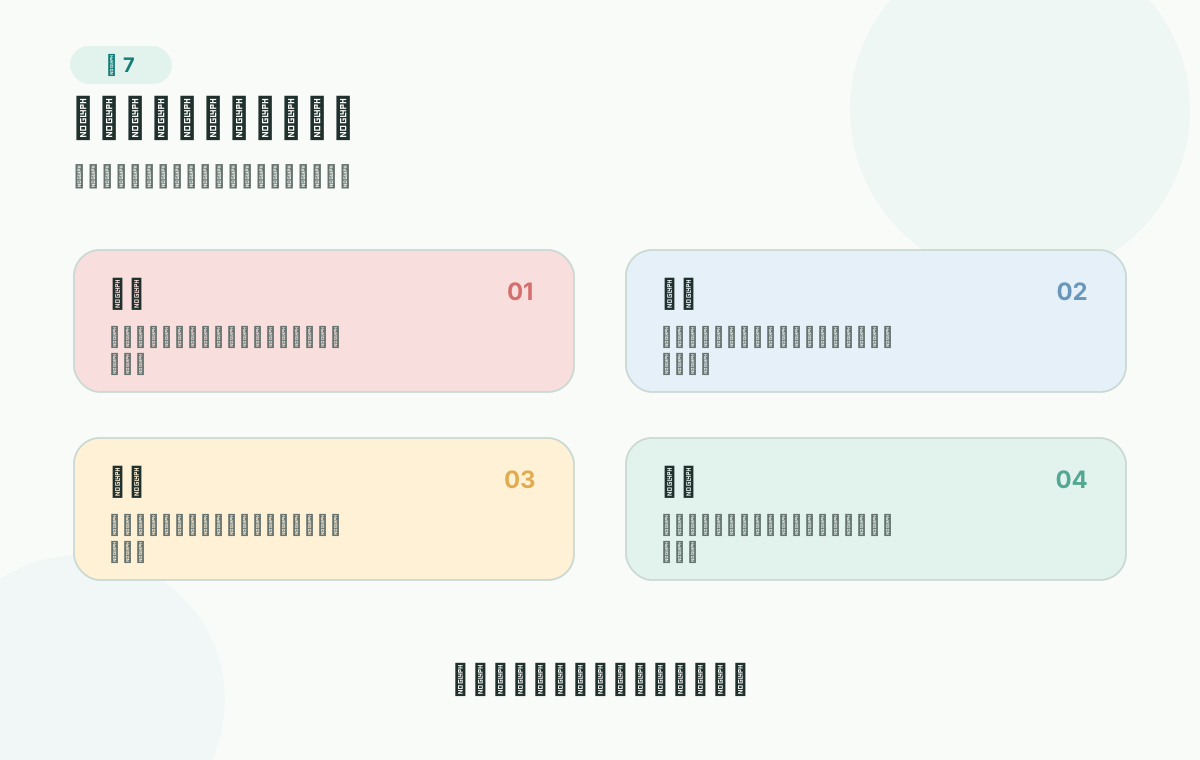
Look At Four Things First
First, is it safe?
Sudden one-sided weakness, face drooping, slurred speech, abnormal vision, severe headache, altered consciousness, seizure, self-harm or suicidal thoughts, plans, or actions, severe loss of impulse control, hallucinations, or delusions should be handled as an emergency or mental-health crisis first. Once safety risk appears, do not keep advising, arguing, or watching.
Second, has function been affected?
Mental state and cognitive change deserve attention not mainly because a word sounds frightening, but because life has been changed over time. Can the person sleep, eat, attend school, work, care for family, leave the house, cook, take medications, handle money and information, and keep basic connection with people? These are closer to what families should observe than "what is the diagnosis called?"
Occasional anxiety does not equal an anxiety disorder. But if fear of mistakes, medical tests, or other people leads someone to repeatedly check, search, avoid leaving home, and live in a smaller and smaller radius, it should not be dismissed as "thinking too much."
Occasional low mood does not equal depression. But if someone has had lower interest for a sustained period, changes in sleep and appetite, slowed movement, worse attention, feelings of worthlessness, helplessness, or hopelessness, or says they want to disappear or hurt themselves, encouragement and reasoning are no longer enough.
Occasional forgetfulness does not equal dementia either. But if an older adult repeatedly asks the same question, struggles to find words, makes mistakes in familiar tasks, shows clearly worse judgment, gets lost outside, or has money and medication safety affected, it should not be covered over with "everyone is like this when old."
Third, is the family's response making the situation more trapped?
Common family solutions sometimes become new pressure. The more the family pushes, the more the child hides. The more the family says "nothing is wrong," the more the anxious person feels unheard and keeps checking. The more the family covers for an older adult, the less real change the clinician sees. The more the family says "be positive" to a depressed person, the more that person may feel like a burden.
This does not mean anyone is bad, or that anyone lacks love. It means the family needs to pause and ask: could the way we keep responding be maintaining the problem?
Fourth, can support connect?
Support does not mean turning family members into therapists, and it does not mean watching someone all day. Support means recording facts, lowering shame, connecting care, follow-up, school communication, companionship, and family roles. Often the useful thing is not one perfect sentence, but one concrete action: I will help you book the appointment; I will help organize a week of records; I will not let you carry tonight alone; I will ask the clinician with you what the next step is.
Why We Misread It
Mental-health problems are often moralized.
People say, "Think positive," "Don't overthink," "Everyone is tired." These words may be well intended, but for the person hearing them, they often become another sentence: you are like this because you are not strong enough, sensible enough, or hardworking enough.
That creates a second layer of suffering. Anxiety is already painful, and then the person starts blaming themselves for being "so useless." Insomnia is already exhausting, and then the person fears, "If I cannot sleep again tonight, I am finished." A depressed person already has trouble acting; hearing "just go outside and walk" can make them feel they cannot even do the simplest thing.
Cognitive change is also easily covered by age.
An older person's forgetfulness is not necessarily dementia. With aging, occasionally misplacing keys or briefly failing to recall a name may be normal memory change. But if the change affects daily life, judgment, language, orientation, and safety, it is no longer just "poor memory." Sudden confusion, abnormal behavior, or clearly worse walking may relate to infection, dehydration, medication, metabolism, cerebrovascular events, and other issues that need professional judgment.
Another misunderstanding is treating brain health as only "something in the brain."
The brain does not work in isolation. Sleep, blood pressure, glucose, cholesterol and triglycerides, exercise, hearing, vision, pain, social contact, medications, and chronic-disease management all affect attention, mood, and cognition. An older adult becoming quiet may be low mood, but it may also be poor hearing, poor vision, pain, fear of falls, or long-term loss of meaningful daily roles. An adult with palpitations and chest tightness may have anxiety, but heart disease, thyroid disease, anemia, and medication effects may need to be ruled out first.
So the better question is not "Is this psychological or physical?" It is: what has changed recently across the body, mood, sleep, relationships, and function?
Emotional Distress: Do Not Ask Only Whether Someone Is Happy
Low mood, sadness, and stress happen to everyone. What deserves attention is whether they persistently affect function, especially whether they shut down a person's sense of future, ability to act, and connection.
Do not ask only, "Are you unhappy?" Also look for:
- clear loss of interest and pleasure;
- changes in sleep, appetite, weight, energy, and attention;
- effects on school, work, caregiving, social contact, and daily life;
- long-running self-blame, worthlessness, helplessness, or hopelessness;
- signals such as wanting to disappear, self-harm, suicide, saying goodbye, or giving away instructions.
Some depression is not crying. It can look like numbness, exhaustion, slowness, emptiness, and inability to act. Someone who still looks functional at work may still be in serious difficulty inside.
The family's role is to recognize that the pain is real, accompany the person to care and follow-up, help organize symptoms, sleep, appetite, medications, and functional change, identify self-harm, suicide, and hopelessness signals, and maintain the minimal structure of daily life alongside professional help. Diagnosis and medication decisions belong with professionals.
Anxiety: Translate The Alarm Into Information First
Anxiety is not the enemy by nature.
It is like an alarm that warns of danger, insufficient preparation, loss of control, or uncertainty. Anxiety before a presentation may remind someone to prepare more. Anxiety after an abnormal checkup may remind them to book follow-up. Anxiety when a child changes state may remind a parent to record sleep, school, social contact, and safety signals first.
The problem is that the alarm can hijack life.
Someone worries something is wrong with the body, so they search repeatedly, ask repeatedly, and buy repeated tests. A short moment of relief passes, and new uncertainty returns. Someone fears making a mistake in a meeting, so they avoid speaking more and more, and opportunities shrink. A parent worries a child has no future, so one lie, one grade fluctuation, or one refusal to go out becomes a disaster story. The more the parent fears, the more they control.
I have also seen another typical trap.
A person repeatedly has palpitations, chest tightness, and shortness of breath. During attacks they feel as if something terrible is about to happen. They go to the emergency department several times and have ECGs, blood tests, and other evaluations. Dangerous conditions are ruled out again and again, but fear does not disappear. The family says, "Doctors said nothing is wrong. Stop overthinking." The person becomes more afraid: if nothing is wrong, why does the body feel so terrible? So they search more, repeat tests, become afraid to exercise, and become more afraid to go out alone.
Later, a clinician does not simply deny the body feeling, but changes the question: when do these attacks happen, what happened beforehand, what does the person avoid afterward, how are sleep and stress, which dangerous conditions have been ruled out in the ED, and which symptoms are still not explained by testing? Once the physical danger boundary is handled seriously, psychological evaluation is connected. For that person, the message is not "you are not sick." It is the first time someone acknowledges: the alarm really sounded, and the alarm system itself also needs care.
This story absolutely does not mean chest tightness, palpitations, and breathing difficulty should all be attributed to anxiety. Chest pain, breathing difficulty, stroke-like symptoms, altered consciousness, and severe pain always go first through warning-sign handling. The real reminder is another point: when physical testing cannot explain all suffering, or when someone is circling fear through repeated testing and avoidance, connecting psychological evaluation is not shameful, and it does not mean the clinician has "stopped caring about the body." It puts body, emotion, and function onto the same map.
At that point, "I am anxious" can be translated into four sentences:
What I am worried about is:
The outcome I fear is:
The facts we know now are:
The smallest next action I can take is:
Once anxiety is translated, it can change from fog into a question. If the concern is an abnormal report, organize records and ask clearly about repeat testing. If the concern is a child's state, first record sleep, school, social contact, and safety. If the concern is a parent's cognition, record concrete function rather than saying, "Are you getting senile?"
If anxiety lasts for weeks to months and clearly affects sleep, school, work, social life, or family relationships; if panic attacks, severe avoidance, trauma reactions, compulsive behaviors, substance use, or physical signals such as palpitations, chest pain, or breathing difficulty appear and physical causes cannot be ruled out, do not rely only on self-help.
Cognitive Change: Record Life Function
When judging cognitive change in an older adult, what the family most needs to record is not "their memory is bad," but concrete life function.
You can look in six directions: attention and response speed, whether cooking, driving, and caregiving have become unsafe; memory and language, whether the person repeatedly asks the same question, forgets important appointments, struggles for words, or speaks less coherently; judgment and planning, whether bill payment, medications, routes, simple finances, and scam risk are affected; mood and sleep, whether there is persistent low mood, irritability, anxiety, insomnia, or clear fluctuation; movement and balance, whether walking is unstable, falls are frequent, movement slows, tremor appears, or sudden one-sided weakness occurs; social connection and interest, whether participation clearly decreases, past enjoyable activities are abandoned, or isolation lasts for long periods.
These observations are not meant to diagnose a parent. They are meant to give medical conversations a factual base. What a clinician needs is not only "we feel they changed," but "in the past two months, medications were missed three times, the stove was left on once, money was sent to a stranger once, sleep has been poor, and walking is less stable than before."
Long-Term Maintenance: Protect The Body Base And Social Connection
When there are no obvious symptoms, it does not mean "nothing needs attention." Long-term brain maintenance does not depend on one brain supplement. It depends on the body base and life connection.
The body base includes blood pressure, glucose, cholesterol and triglycerides, sleep, activity, pain, hearing, vision, dental health, medications, and chronic-disease management. They sound scattered, but together they affect brain vessels, attention, mood, cognition, and life radius. Brain health is not "feeding the brain" alone; it is keeping the body usable and life supported.
Life connection matters just as much. Going out to meet people, taking part in housework, contacting old friends, caring for plants, grocery shopping and cooking, walking with grandchildren: these ordinary activities are everyday supports for brain and mental health. For older adults, handling poor hearing, poor vision, pain, and fear of falling may be more practical than urging them to "use the brain more."
How To Start The Conversation At Home
Do not begin with: "Are you depressed?" "Are you having cognitive problems?" "Do you have a mental problem?"
Use more specific and less harmful sentences:
- "I have noticed you have been sleeping badly and are very tired during the day. Should we record this together for a week?"
- "The last few times you went out, you seemed a bit unsteady. I am worried about falls. Let's write down what happened and ask the doctor."
- "You seem to have had a hard time feeling happy lately and do not want to see people. You do not have to carry this alone. Let's talk with a professional together."
- "I will not start by asking why you are like this. Today let's first see how to make things a little safer and lighter."
- "This is not about who is right or wrong. Let's first describe clearly what has changed."
The point of family communication is to reduce shame and increase the possibility of action. Especially with children, partners, and parents, do not turn care into judgment, and do not turn safety into long-term control. When danger is clear, staying nearby for a short time, removing tools that could cause harm, and contacting emergency or professional help is protection. After the crisis eases, professional help should be connected as soon as possible so boundaries and support can be reassessed.
When Not To Keep Watching
Seek help promptly in these situations:
- sudden one-sided weakness, face drooping, speech difficulty, abnormal vision, severe headache, vertigo, unsteady walking, or altered consciousness;
- self-harm or suicidal thoughts, plans, tools, actions, goodbye messages, or preparations;
- severe depression, anxiety, panic, or insomnia already affecting basic life;
- hallucinations, delusions, clear behavioral loss of control, or long periods without sleep with obviously abnormal behavior;
- a child or adolescent mentions not wanting to live, self-harm, harming others, or shows clearly unsafe behavior;
- an older adult suddenly becomes confused, does not recognize people, acts abnormally, or walks much worse;
- cognitive and behavioral changes appear after a recent fall, infection, dehydration, new medication, or medication adjustment.
In the United States and Canada, if there is an immediate safety risk, call 911 or go to the nearest emergency department; for suicidal crisis, mental-health crisis, or substance-use crisis, call or text 988. In other regions, use the local emergency number, crisis line, or emergency department.
Families can accompany, record, and push care forward, but do not use encouragement, persuasion, or reasoning as a substitute for professional help.
Make A One-Week Observation Card
Pick someone you care about, or observe yourself, and make a one-week brain-function card. You do not need a long medical history. The point is to make change visible:
Safety: Any self-harm, suicide, thoughts of harming others, plans, tools, or actions?

Function: Sleep, eating, school, work, housework, medications, going out, social contact, money, and judgment: what changed?

Body and mood: Palpitations, chest tightness, pain, falls, unsteady walking, low mood, anxiety, irritability, numbness: how long has it lasted?

Next step: What is the smallest support action for tomorrow? Is a doctor visit, emergency care, or mental-health help needed?
Write only two or three sentences each night. The point is not to prove who has a problem, but to let change be seen. If the person observed is a parent or older adult, put this card into the Family Health Record And Chronic Marker Log, and use it with the Doctor Visit Checklist before follow-up.
References
As of 2026-06-28, this chapter mainly uses CDC materials on stroke signs, dementia signs, and reducing dementia risk; NIMH materials on depression, anxiety disorders, and suicide prevention; NIA/NIH materials on cognitive health in older adults; and SAMHSA 988 information to calibrate boundaries around stroke, cognitive change, depression, anxiety, and mental-health crisis.
These materials are used to calibrate boundaries around stroke, cognitive change, depression, anxiety, and mental-health crisis. This page does not provide diagnosis, medication advice, medication changes, psychotherapy plans, individualized screening, or individualized interventions.
Start directly with: CDC Stroke Signs and Symptoms, CDC Signs and Symptoms of Dementia, NIMH Depression, NIMH Anxiety Disorders, NIMH Suicide Prevention, and NIA Cognitive Health and Older Adults. More sources are in the source registry. This book's evidence rules are in the evidence policy.
Summary
The first step in brain and mental health is not labeling. It is seeing safety, function, pattern, and support clearly.
When the family faces a larger diagnostic fear, the same principle still holds: first separate the stage and the next step, and do not let fear make decisions for you.